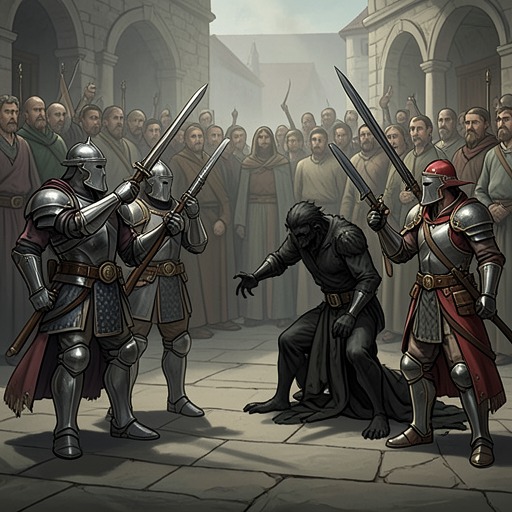
Black Ranger
Vainqueur the DragonBlack Ranger is a member of the Kobold Rangers and one of the group’s defensive fighters. He operates within a team led by Red Ranger, alongside Blue Ranger, Yellow Ranger, and Pink Ranger, and shares their responsibility for protecting the Rangers’ settlement and its cultivated food. His importance is most clearly revealed during the confrontation with the Black Rabbit, where his courage and endurance help define the group’s resistance even after the battle overwhelms him.
Identity and Place in the Rangers
Black Ranger belongs to a collective whose work combines outlaw identity, military organization, and dependence on a larger hoard-centered economy. The Rangers sell captured goods so that Vainqueur Knightsbane’s hoard will grow, a practice that has given their labor a lasting meaning within their culture. Black Ranger is therefore not presented as an isolated adventurer but as one component of a tightly coordinated monster society, in which individual survival is tied to the defense of shared resources.
The Rangers are equipped according to their different battlefield functions. Red Ranger carries the musket and rapier supplied by Victor Dalton and remains the group’s visible leader. Pink Ranger and Yellow Ranger use bows, while Black Ranger and Blue Ranger carry spears. This arrangement places Black Ranger in the close-defense portion of the formation: he is expected to meet enemies at the perimeter rather than attack from a distance or direct the entire engagement.
Combat During the Black Rabbit Attack
When the Black Rabbit appears, the Kobold Rangers establish a defensive perimeter behind Rolo’s fields of carrots and lettuces. The position gives the fight a concrete stake: the Rangers are not merely confronting a dangerous monster, but shielding the food on which their community depends. Black Ranger stands with a spear while Pink Ranger and Yellow Ranger prepare their bows, and Red Ranger takes the front with his musket and rapier.
The Black Rabbit’s threat is far beyond that of an ordinary opponent. Pink Ranger recognizes it as a legendary beast more terrifying than Gustave La Muraille, who had killed Blue Ranger and Yellow Ranger in the past. Even though the Rangers have levels in the Outlaw class, only Pink Ranger and Red Ranger have developed additional combat-oriented classes. Black Ranger consequently enters the battle as a capable but comparatively exposed defender facing an enemy whose power exceeds the group’s preparation.
The initial defense depends on the Rangers’ ability to keep the creatures emerging from the burrows away from the crops. As waves of hungry rabbits press forward, Black Ranger and Blue Ranger impale every animal that reaches the line. Their spears make the pair the physical barrier between the attackers and the fields. When Red Ranger and Yellow Ranger run out of projectiles, they join the melee, but Black Ranger and Blue Ranger have already carried the burden of stopping the first rush at close quarters.
Wounding and Collapse
The Black Rabbit changes the character of the battle by raising its golden horn and directing lightning at the defenders. Black Ranger cannot outrun the bolt. The strike hits him in the chest and throws him against the fence, leaving him defeated. His fall shows the limits of the Rangers’ formation: a line that can withstand repeated lesser attackers remains vulnerable to a single concentrated supernatural attack.
Black Ranger’s defeat also exposes the emotional pressure inside the team. Yellow Ranger reacts by breaking formation and rushing toward the Black Rabbit, while Red Ranger warns that this is exactly what the monster wants. Black Ranger’s injury therefore becomes more than an individual setback; it threatens to make the Rangers abandon the defensive strategy that protects the fields. Red Ranger’s intervention preserves the distinction between solidarity and reckless retaliation.
The later account confirms that Black Ranger survives the immediate encounter but is unable to move because the lightning has paralyzed him. He requires treatment from Chocolatine, placing his recovery within the Rangers’ broader network of support rather than presenting his collapse as a final death. While Black Ranger is incapacitated, Blue Ranger is ordered to help him, and the team checks that the vegetables remain safe. His condition thus remains connected to the battle’s central objective: preserving the community’s food while keeping its defenders alive.
Team Loyalty and Narrative Function
Black Ranger’s role is defined through action rather than extended personal biography. He fights beside Blue Ranger, responds to the same collective command structure, and becomes one of the bodies holding the perimeter. The narrative gives him no separate ambition or private history in the supplied episodes, but it makes his loyalty legible through his willingness to remain in the line against a legendary beast.
His paralysis also reinforces the distinctive physical logic of the Kobold Rangers. The group includes living kobolds and kobones, and injury does not affect every member in the same way. Black Ranger is paralyzed by lightning and needs to be patched up, while Yellow Ranger struggles to put his bones back together after the assault. These different forms of damage make the Rangers’ bodies part of the story’s comic and tactical world: they can be battered, broken, and repaired, but their continued usefulness depends on cooperation.
Black Ranger is consequently a compact emblem of the Rangers’ collective ethic. He is not the leader, the archer, or the strategist; he is the defender who absorbs the enemy’s force until the formation can no longer hold. His temporary defeat does not erase that contribution. Instead, it clarifies the cost of protecting the hoard and the crops, while the command to help him demonstrates that the group treats an injured member as a responsibility rather than expendable equipment.